On Czech Political Blunders

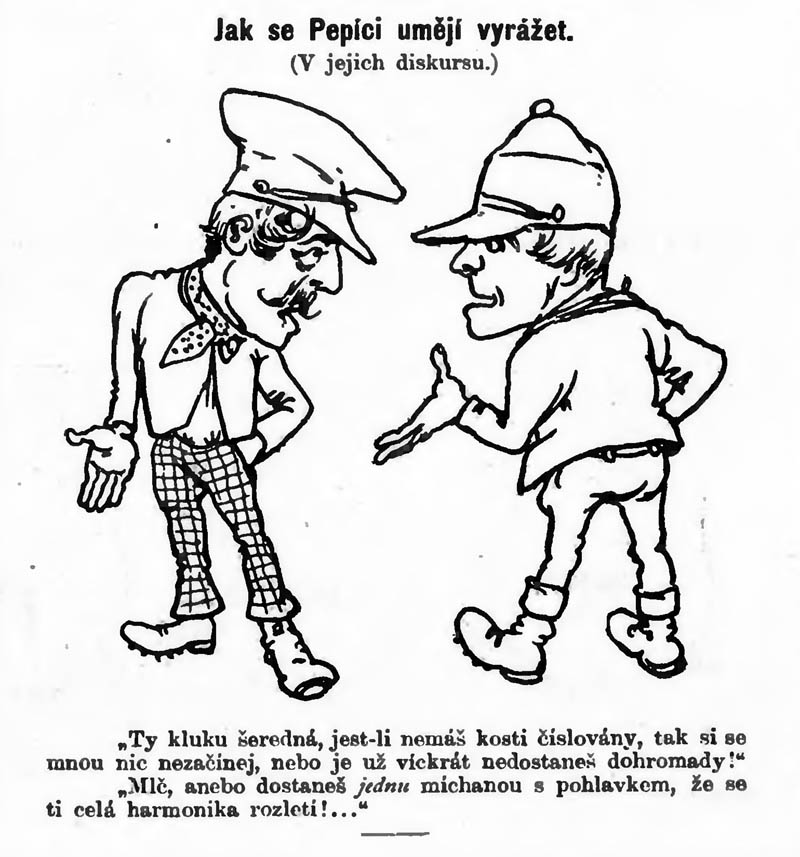
Hádka Pepíků (1886), Humoristicke listy, magazín Paleček; Autor: Karel Krejčík (A cartoon with two arguing "Pepík", members of Prague underclass - 1886); Author: Karel Krejčík

This is off topic post by regular contributor to this blog and political scientist. The post is rather an exception. For you, who are interested just in security/military or IR topics, do not read it.

As I wrote on my Facebook page yesterday referring to Czech presidential elections, out of all dumb-ass stunts Czechs have pulled in their politics this one takes the dumb-ass cake! Now, please bear with me here: this is NOT a blog written by someone whose candidate is on the losing side, for I am a permanent resident, not a citizen of the Czech Republic and thus not having right to vote, but what actually surprised me by far, and this is the point of the blog, is a poorly developed political culture in this country. Believe me, for someone who has spent considerable part of his life in Milošević’s Serbia I am not a person to be surprised easily, but Czechs have definitely managed to do otherwise!

I honestly find it very interesting, and this is now a political scientist talking, to find that considerable number of Czech voters decided on their future president with arguments such as “his wife (not) being Czech,” him “(not) being Czech (and also (not) speaking Czech) enough,” or, and this is my favorite, “him (not) wanting to crawl up German ass.” This only goes to show that, all things being equal, Czechs have been largely perceptive to overtly populist rhetoric and a tactic of political intimidation chiefly present in Czech politics.

To make things even harder, and the whole picture even more obscure, about 40% of voters simply decided not to cast their votes, obviously many of them dissatisfied with politics in general. The elections results should not be a problem, some people might say, for similar electoral reasoning and outcome can be found in other countries as well.

However, what I find shocking here is the fact that the country I used to name a very good example of a liberal social attitudes and a post-communist national success in democratic transition towards a liberal Western-style democracy elected its president with the aforementioned arguments that can easily be described as outdated. Not only that democratic political culture has been seriously compromised with these elections, but, what is even worse, the country’s future course is now largely dependent on how much future president will be pushing the agenda of parliamentary elections knowing that right-wing parties are largely without popular support.

Yes, this is not the president’s job, but knowing how Vaclav Klaus, the current president, has used his position to get cheap political points by advocating against the government, it comes as no wonder that his successor may try the same. Thus, as it seems to me, and quite opposite to what Vaclav Klaus has said, lies, hate, and fear seem to have won the day and many Czechs unfortunately seem content about that.

Podobné příspěvky

18 Komentářů

  1. Pěkný článek, co dodat. Ty diskrepance mezi podáními jednotlivých volebních týmů kandidátů byly zřejmé. Také bylo zřejmé, který volební tábor se uchyloval k intimidacím, a který vůbec. Nyní je tedy zřejmé, nač skoro polovina národa myslí, jak myslí, čím nebo kým se dá ovládat a jak málo stačí k manipulaci. jak se na nás, bohužel, svět dívá a bude dívat. Dobře nám tak.
    Snad mě zase nesmažete, pane Šulci ?

  2. Very interesting article I have to say. As much as I agree with most of your assumptions I have drawn distinctly different conclusions from them. Some of the observations are mine, some belong to my friend Maj Chris Heppler (USMC) who has a Czech wife and spent some time in the Czech Republic.

    I have to agree with his observation. When he was forced to comment on the character of the Czech people, he said that „Czech people are like a good jazz music song – sometimes the tones you do not hear are equally important as those you hear“.

    1. Is it more important that only 60% people took part in the election

    OR that thousands of young people volunteered to support the campaignof presidential candidates in their own free time and 700.000 people took their time and effort to get the permits allowing them to vote outside their town?

    2. Is it more important that sizable portion of the rural Czech population was intimidated by the primitive nationalism and threat of the fictional German retribution

    OR that even more sizable portion of the urban population was disgusted by it and THEREFORE took part in the second round?

    3. Is it more important that the populist left-winged candidate won the easy downhill battle by a slim margin in the middle of economic stagnation

    OR that a member of a conservative party and the extremely unpopular government was able to gather over 45% of votes in spite of saying the inconvenient truth and refraining from the negative campaign of his opponent?

    In my opinion, in spite of the fact I may not like the result personally, it is actually rather good report of the state of our democracy. The democracy is not about doing the right choices all the time, but about the ability to correct the bad ones.

    Even Austria, the country with much more advanced democratic tradition, has recently made a mistake with Jorg Heider’s fascist party that was allowed in the government. But the Austrians corrected the mistake and where is Jorg Heider and his party now?

    Do not worry, this country is not going back to the late 1990s, the people and media are much cautious than they used to be. We will just be fine. The democracy knows no shortcuts, it needs time.

  3. Thank you for the article and for the comments, all of which I agree with. There are two more points, I would like to offer for discussion here.
    1) apart from the above mentioned political culture in the Czech Republic, or the lack of, one of the most defining issues of the presidential election was selective historical memory of the Czechs. In this respect I have to bow to Milos Zeman for leaving the politics ten years ago to be forgotten, but coming back from time to time, not to be forgotten completely. Brilliant move of someone who probably knows the Czech mind set very well and uses it to his advantage.
    2) My second point is rather more alarming, but also says a lot about the Czech political culture. I am shocked that it has not been picked up by the mass media – do we really consider it normal that a Czech Army veteran, dressed in the current uniform (issue 97) takes an active part in Zeman’s political campaign. (I am talking specifically about the one veteran who took part in one of the presidential debates, although I am aware that there were more interviews and appearances of other veterans in support of Zeman). Is it not a direct breach of a fundamental principle of civil-military relations instructing the military to stay out of politics? I think it is!
    It may had been acceptable if he came to the TV studio NOT wearing a uniform. While I acknowledge his life-long entitlement for the uniform for special occasions, I must insist that wearing it means representing ACR and there is no place for it in political campaigning. I have spoken to few current ACR officers about this and they were all puzzled by it.
    I am convinced that this was yet another mistake of Zeman’s election team, which has gone unpunished by the voters. As mentioned by Ivo (above), perhaps one of the tunes in Czech jazz music that has gone unnoticed…

  4. Thanks Ivo, I wouldn’t be able to express myself more clearly than you did. I agree with you fully.
    Yet I still have to add that it worries me that some of the issues re-introduced during the campaign still find theirs audience.
    I would have hoped that the (mis-)deeds of our grandfathers would not haunt our society any more and that even the elderly people have general believe in the stability of our country and the status quo in Europe.

    Having said this I should also add that I am glad to notice that we (as a nation) learned to become sensitive and irritated with campaign without actual content no matter how professionally it is managed.

  5. Dear Kristina and Ivo,
    thank you for the useful comments. I would like to point out that, as much as Ivo’s comments are concerned, it is definitely important to see 40% of the population not voting since, in my opinion at least, this is a considerable portion of the population dissatsfied with „state of democracy“ in the CZE. Here I am talking about people whose dissatisfaction with all the blunders of the Czech politics may them not care about future course of the country. Thus, by nature of political systems and elections, those not voting actually choose to agree with election results whatever these may be and thus give legitimacy to the winning party. On the other hand, and very much concerned with the first point, it is definitely hard to speak about „more sizable portion“ knowing how many people voted. Last but not least, I find the discrepancy between rural and urban population in the CZE really disturbing (even in a historically more economically advanced Bohemia) and believe that any future government needs to tackle this issue seriously.
    Cheers!

  6. Dear Mr. Đorđević,

    I must say I am disappointed by your hasty analysis (or should I rather use the word judgment?) of the whole Czech political culture in a few short paragraphs. Needless to say I disagree with the conclusions you have presented.
    Furthermore as a political scientist I would expect you to take a more sober approach and draw upon more data than a single election poll and take more time to analyze the hard results. The article you wrote was a view without giving the benefit of a doubt, no attempt to give the opposite possibility a thought. That had to be presented by Ivo’s comment for which I thank him.
    And finally the coarse language surely does not suit an article by an author with an academic background.

    Petr D.

  7. Dear Petr,

    first of all, thank you for the comments, for they are more than welcomed!

    Second, please bear in mind that this is far from an academic article PRECISELY due to the language used and the FORM in which this writing is presented. Thus, this is a BLOG rather than anything else, and, in addition, precisely because it is a blog, it represents a view on a particular matter in a particular moment in time. Moreover, blog being short gives everyone an opportunity to discuss a particular matter and get respective answers as fast and short as possible. Therefore, I certainly had no intention (or could not have done so even if wanted) of presenting a thorough analysis in a matter of only a few lines.

    Last but not least, I have seen Ivo’s comments and appreciate them very much, but please bear in mind that I have also presented my own counter-arguments here in the Comments section. In that respect, I find it difficult to understand what you mean by „hard results“ since, in my opinion, 59.11% of voters taking part in the elections is not really some stunningly high participation ratio (or perhaps it is in your opinion!) and, whether we may like it or not, these elections were clearly won by populist rhetoric rather than anything else. That being said, what my arguments were aiming at was exactly to point out where Czech political culture is in this very moment (quote from the text: „Not only that democratic political culture has been seriously compromised with these elections,…..“) and what difficult choices it is actually facing.

    Cheers!

  8. Ad Kristina Soukupova)

    1. I have to slightly disagree with your first point. It is not that much about the selective memory as about the importance of those memories. We both are presumably still outraged about the state of affairs in 1998-2002, the rise of corruption, the unsuccessful attempts to murder journalists by government officials in that time period etc. Some other people are not, but not because they forgot, but they have more pressing issues to deal with.

    I am pretty sure that we are both familiar with the Maslow’s pyramid of human needs. The education obviously plays its part, but cannot fully explain why the inhabitants of Prague have such a better memory than struggling people from the country side. As soon as the real or perceived living conditions improve, we will suddenly see the end of collective amnesia. I may be wrong, but this is the best answer I was able to come with.

    2. The issue with the uniformed soldiers in the campaign was an unfortunate event, nothing else. Theoretically punishable, but since the soldier was a retired 90 years old WW2 veteran, no court will give any verdict.

    What on the contrary was remarkable was the conversation between the candidate and the veteran. It could not have happened in the United States under any circumstances. The first rule of mass communication – never argue with veterans, handicapped people, priests etc. in front of TV crews, since you CANNOT win the argument no matter how ridiculous the facts presented by the other side are. I was really surprised he fell for that trap.

    Ad Vladimir Dordevic)

    1. I fully agree that the rift between the cities and the country side is disturbing and if not dealt with can mean serious problems in the future.

    2. Even though we are still lacking any hard data (there were no exit polls this time) I believe that your assumption that the issue of nationalism lost the election for Karel Schwarzenberg is incorrect. See my comment to Kristina about the Maslow’s pyramid.

    I cannot seriously imagine that a candidate from a right winged party after 6 years of a right winged government (and presently extremely unpopular) had any serious chance against left-winged populist politician who has no scandal in the last 10 years (for the obvious reasons). Again, we both can pretty easily disassociate from the fact that he is one of the government’s ministers, but most people simply cannot.

    BTW off course I wish all the voters would be like those participating in this discussion, but they are not and will not be any time soon. I have three deployments in Afghanistan under my belt and I learnt one thing there – PATIENCE :-). Our first president T. G. Masaryk expected the democracy to fully develop in 50 years. We have not even entered the second half-time yet :-).

  9. ad Ivo)

    thanks very much for your comments and please allow me to react.

    re selective memory – What I meant by saying that Czechs have selective memory is not they forget some events over other events, but it is precisely that Czechs choose (willingingly or subconsciously) which memories to connect with current events. I have read elsewhere that the ability of Czechs to distinguish among serious media and tabloids has severely diminished. So I would propose that the election also showed how easy it is to manipulate people to „remember“ things which had absolutely nothing to do with anything (such as Benes Degrees). I do not even want to go down the road of connecting education to this, although I do agree that it plays a huge role. I simply do not want to make generalizations that people in urban areas are more educated than those in the country (I was born and bread in Prague, which makes me automatically bias on this issue). I do see a parallel of the Czech country side/urban areas divide to British politics, where the North of the country, which has been traditionally leftist, while the South voted conservatives. I see the reasons for such voting pattern and I am convinced that the typical Czech Progocentrism does not help anyone in this sense.

    re Veteran in political debate – I cannot help myself but be my true cynical me here – Mr. Schwarzenberg perhaps fell for that trap because he felt he was debating with someone of approximately his age and therefore saw no reason to treat him differently. Jokes aside, I did not even in my wildest dreams suggest that the veteran should or would be brought to court. What I wanted to draw attention to was the fact that I didn’t see any reaction in the media questioning this move by Zeman’s election team. Perhaps this takes us back to the selective memory discussed in parallel here. Is the fact that no one noticed it caused by our indifference and the very special civil-military non-relations in the Czech Republic or is it because we were so used to seeing military officials side by side with politicians for almost 40 years?

    I really value the level of this debate and the fact that all participants can discuss these issues in such a calm and reasonable matter, which one cannot say about another presidential discussion on this blog, funny how language of instruction can be (and in this case is) defining.

  10. Just a few observations:
    Ad the presumable rift cities v. country side:
    If you glean over the interactive map of election results (available on the idnes site) broken down by regions and districts, you cannot help but to see a strong correlation between a general level of economic prosperity of those districts and the percentage of voters casting their vote for KS.

    Hence my Hypothesis #1: a decisive portion of voters have voted in line with their overall perception of their social & financial situation, degree of their personality development (which includes ability to view things from different angles, or rather a lack of it) and their subjective reflection of the political and economic conditions in the country as influenced by the aforementioned factors.

    The campaign itself had an impact mostly on undecided voters (which is actually the reason for one, isn’t it) in round 2 who voted for Jan Fischer in round 1. But my Hypotheis #2 is that although MZ fared much better in that respect he would have won anyway.

    Ad degree of political culture in this country: Here I strongly disagree with the author of this article. I will comfortable resort to the opinion of Erik Best, who usually dosn’t have to go too far for a harsh words when it comes to Czech politics, but on this one he noted that although some unfair hits were evident, it was to be expected and, by comparison, the recent US presidential campaign was in this respect much, much worse.

    Despite my preferences I must concede that the better candidate has won. Not from the perspective of the agenda he will try to push through, but from the angle of his team’s performance in the campaing. Both on strategic and tactical level it was without material mishaps.
    The campaign of KS was lukeworm from the begining, he made an appereance of someone who is obliged to go into it as it is a „proper“ thing to do, but doesn’t believe himself he could win. It was almost palpable. Only when the cultural elites woke up after the Christmas (Budget targets met? Sorry, that was cheap one:-) and to their detriment realized that Fischer is „even bigger loser then we had hoped“ and MZ is well on the course to win, they issued their proclamation and things were gathering some momentum, at least from my biased perspective. It was enough to make it to the round two (a nice surprise for me indeed) but not enough to win.

    On a tactical level, the unenforced blunder re. the infamous Benes decrees was „worse then a crime, it was plain wrong“. A professional politician in general and foreign minister in particular can’t afford such a misstep, not to mention a candidate who is serious about winning elections in this country! (I put the material aspect of the whole issue aside) BTW, his statement was factually incorrect.

    But, by whole and large, as Ivo mentoned above, the resul is, IMHO, overly positive. A candidate who is a noble man (in the plebeian Czechia) and very wealthy in that (and partially thanks to the restitutions), has a dual citizenship, his Czech is far from great, his broader family was very close to the Habsburg throne and his father was as a young politican at least flirting with fascism (and many people in this country can not tell fascism from nascism and forget that in the 30’s it was – and in Italy to some degree still is – a fully legitimate way of political thinking), this man has put up a good performance and lost by 10% in the second round. If you told me so 3 months ago, I would tell you you’re kidding me.

    Regarding MZ, I recall only too well his „burnt country“ rhetorics of the mid 90’s. After he became the PM, he turned out to be a quite left-centristic pragmatic. So we have to wait to see we he’s really up to this time.

  11. democracy by its very definition is waltzing on a thin line, risking either slipping to communist dictature or to nazi dictature.

    as long as „abstaining from vote“ by elected deputies will be seen as valid decision, we can hardly expect general public to be more disciplined electorate. unless our representatives are penalised for abstaining or missing at legislative votings, we cannot hope for growing political culture mimicking political culture of Great Britain or other long life democracies.

    you should notice that significant portion of Zeman’s voters overestimate President’s rights and privileges, hoping that „Zeman will protect us poor“

  12. Ad 12: Yes. I guess I should get something to read about Gen. Sherman, in English of course :-)

    Ad 13: Frankly, I don’t recall the last time I read the constitution myself.

    Regarding the false hopes, all three hot candidates were „sure bet“ for business, with well established connections and practices. But in the local Czech party politics, it will definitelly be more fun with „taťka Zeman“ then with the other two.

  13. Ad Aleš Čížek)

    1. I fully agree with your #1 hypothesis. That is exactly I was trying to express so ineptly by the description of the Maslow’s pyramid of human needs. The #2 is true as well, but is self evident.

    2. I highly recommended to read it, his policy is still well remembered in the southern states where I am currently residing :-).

    Ad Kristina Soukupova)

    1. I am sure if the soldier were still in the active duty, the reaction of the media would be very different.

    2. Yes, but I do not think that the cause of calmness of this discussion is caused directly by the influence of English language. The explanation is far simpler – by using the lingua franca of the majority of supporters of one side, we effectively excluded the other, don’t you think :-)? I have a feeling that the proportion of those with substantial command of the English language and those with none is almost symmetrically reversed in both camps ;-).

  14. Interesting article indeed. On the other hand I cannot agree with the overall theme of the article. The solution is not more political correctness as is suggested (it does not work, believe me I can see it every days first hand), but rather the ability to internalize the inconvenient truth by the majority of our population.

    When the majority of our society, not just the elites like Vaclav Havel, find the inner strength to admit publicly as well as to themselves something like „In the year 1945 the ethnic Germans were moved from Czechoslovakia to Germany in spite of the fact that majority of them did not do anything wrong. During the process thousands of them died by the hands of their Czech neighbours due to their fanaticisms as well as their greed. The process was probably historically inevitable, but there is nothing to be proud of and would be unjustifiable by today’s standards“, we will finally become stronger self confident nation.

    Until then we will continue to act like stubborn teenagers.

    Was it better or worse in the history? Look at the following link. The whole essays is worth to read, but the most important part is „On Democracy“, the second paragraph. Enjoy :-).

    http://tabery.blog.respekt.ihned.cz/c1-59023780-k-cemu-byt-loajalni

  15. Political correctness is only one (sic!) of the means how to achieve internalization of norms that are linked to the ideal political culture. USA might be an extreme in some ways, but at least it is trying to provide equal conditions opportunities through language and political behaviour. And in some ways is this way successful.

    CR on the other hand have not experienced almost any attempts of political correctness and it is already stigmatized as something limiting ones freedom of speech.

    Do not forget that language is a powerful tool for constructing social reality, so to a priori reject political correctness might be a mistake.

    Thanks for the article. Point of interest, Capek is describing the imperfections of a young democracy, in many ways we are in a similar situation…

Napsat komentář

Vaše e-mailová adresa nebude zveřejněna. Vyžadované informace jsou označeny *